Welcome to Char Lutheries!

I’ve always had a fascination (some might say obsession) with musical instruments. I find them to be the perfect blend of art, craft, and function combined into one beautiful sounding object. That core fascination is sill a driving force in my work. In this column, along with sharing photos and comments of the new instruments I have built, I will also share photos of some of the cool, unusual, and just plain weird things that come into my shop form week to week. Most are from customers, some of them I own, some of them just show up on my doorstep! Hope you enjoy it. Kerry Char


Travis Stein plays Spain

December 22nd, 2011

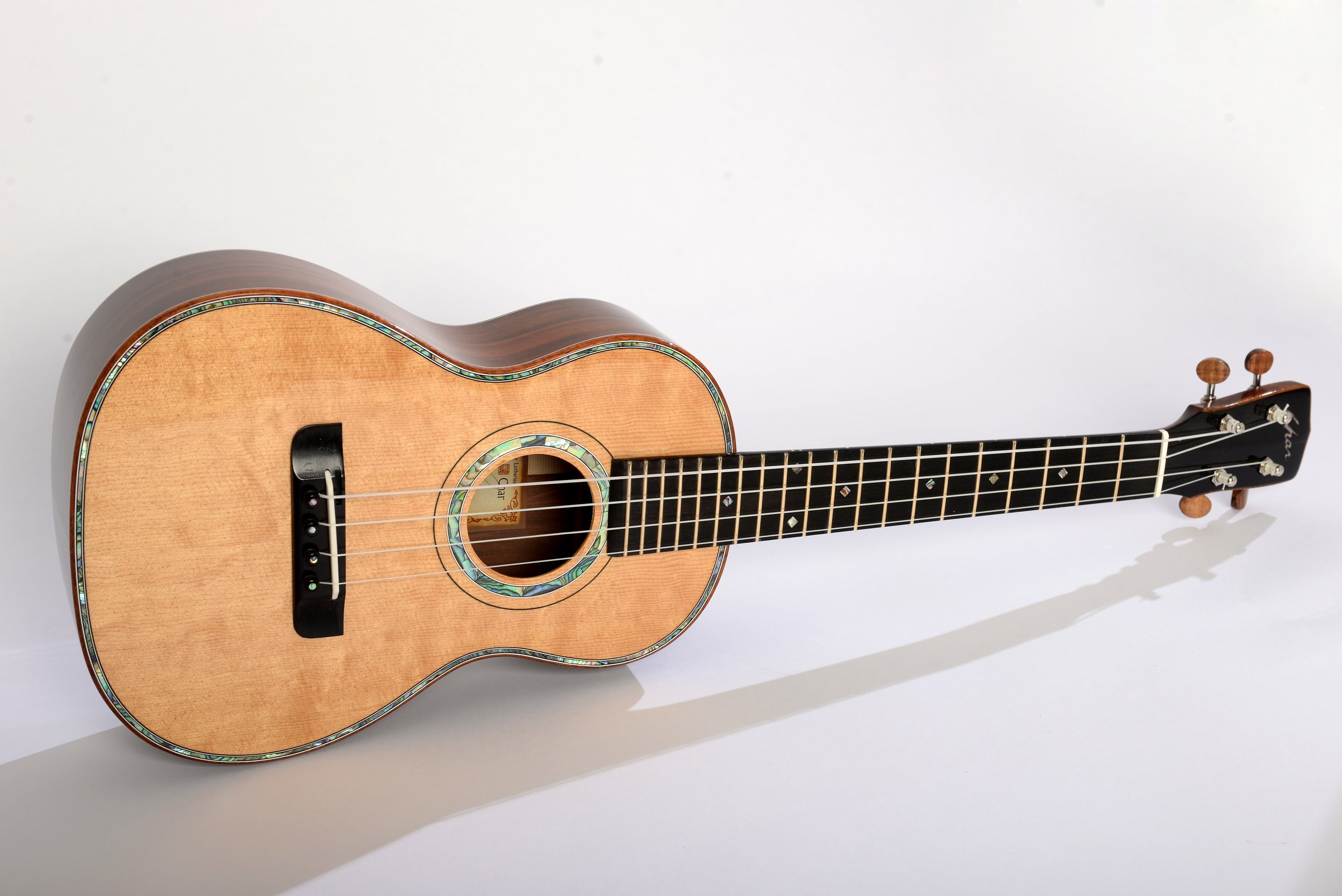
Thought I would share this video by Travis Stein and Dane Lum Ho. Their version of Spain By Chick Corea.I built Travis this Tenor uke this last year and he he has been making good use of of it as you’ll see. This is an awesome instrument. Back and sides are Brazilian Rosewood the top is Adirondak Spruce with Martin 5K type inlays.

Click here to see video.http://www.youtube.com/watch?v=sz-Al1svBLgIMG_3822.JPG

Making the “Radio Tenor”

November 11th, 2010

IMG_2565.JPGIMG_2566.JPG

Two summers ago the girls and I went to Hawaii for a family reunion. I had a little time on my hands so I thought I would get  around to some of the Uke shops and check things out. Probably one of the most impressive shops on the island is Pua Pua, http://ukulele.pua2.com/ and its right down town Waikiki in the Pacific Beach Hotel.  It’s a small little shop but totally packed with ukes! Wall to wall ukes. I met the manager there, Tyler Gilman. A really super nice guy and a super great player . He gave me a couple of books he thought  would be of interest interested to me. They chronicled the Tony Ku Collection. One book showed his uke collection and the other his Hawaiian style guitars. My understanding is that this collection is no longer together so it is so cool that they chronicled his collection because it was  truly impressive. I was immediately wowed by  the vintage pieces he had by Santos, Diaz and of course Nunes. The inventors of the Ukulele. These ukes are so rare you never get to see them. They are mostly all in collections. This was the first time I had ever seen a “Radio Tenor” model built by Leonardo Nunes. Before that I had never even heard of one.It was such a beautiful and cool uke I really had to make a reproduction of it. In my research of this uke  I eventually met Jeff Turner, a collector, who has several really fine examples of them in his collection. He told me that of the “Radio Tenors” He only nows of maybe 20 of them. They are that rare!  Jeff was a wealth of information, and very  encouraging about my project. He gave me drawings and measurements from the original instruments he owns. Needless to say I couldn’t have done it with out his help.

IMG_2541.JPGI building the Radio Tenor the first thing I decided to do was to use original construction methods.That meant using the “Spanish style” of construction which historically was how all the ukes from the islands were built. In this style of construction the neck and body are built together as one and not separate pieces. All ukes from the main land were made with the body and neck separate. The majority of people who build instruments these days build with the separate body and neck construction method so building in the “Spanish style” was  a bit of a learning curve for me.  Switching over required making some new jigs and molds as well as a bit of recalculating. The rest of it was pretty straightforward.IMG_2532.JPG I made the rope bindings from Mahogany and Holly. Everything else was Koa. I decided to French Polish it for a finish instead of Lacquer. I wanted to give it that lovely patina that those old ukes have. IMG_2556.JPGSurprisingly the most frustrating, and most expensive!, thing in this project was getting the decal  and badge made. First I had to get someone to recreate the decal based off of a photo. Then there was finding some one to make the decal. The first company I contacted gave me a quote of $1,600.00! It took me about six months to finally find someone to make me a decal at a somewhat reasonable price. The badge wasn’t too bad. Its not a real acid etched badge but I think its acceptable.

I am traveling to Hawaii next week to participate in the 9th Annual Ukulele Guild of Hawaii Exhibition and I will bring my “Radio Tenors” to show. I think that sounds very fitting.

IMG_2570.JPG

Char Lutheries for Will Leathergoods

November 7th, 2010

KERRY_03.jpgKERRY_08.jpgOTHER_010.jpg

This last summer I got a phone call from A woman named Anna Farrow. She said that she was a documentary film maker by background and that She was doing a piece that featured different crafts people and their work spaces and that it would be used on the web site of a company that designed leather products. If I was interested she said she would get her art director to make an appointment with me. The whole process was surprisingly quick! Anna called me on a Thursday, the art director came Saturday, they shot it on Tuesday and I think it was up on the web about ten days later. It’s pretty cool. Check it out its only a few minuets long.

Click here to see video

Fabricatore circa 1832 ?

August 31st, 2010

IMG_2260.JPGIMG_2268.JPG

This is an instrument I got just recently and am trying to authenticate it. Ive been trying to do a bit of  reading about romantic period  guitars and Fabricatore is one of the earliest  as well as one of the most recognizable  names from that period of guitar building. There are a couple of great sites out there on Romantic Guitars.http://www.earlyromanticguitar.com http://www.crane.gr.jp/indexE.html

The guitar is as I received it. The original owner had some work done to it before I got it  attempting to stabilize the guitar as it had quite a bit of worm damage to the back and sides. The top though is in excellent condition.

Knutsen 6 String circa 1910

August 31st, 2010

IMG_2239.JPGIMG_2242.JPG

This is the first blackface Knutsen 6 string I have seen. This one is in really great shape now . Super playable with that melodic ethereal sound you get with these Harpguitars even though this one doesnt have the bass strings. Mahogany back and sides with, I think, a cedar top.

Favilla Bros. Harpguitar

August 29th, 2010

IMG_2167.JPGIMG_2169.JPG

Most of my exposure to Favilla instruments has been through their ukes, especially their Baratone uke which I think is the best factory made one out there. The Favilla company, in fact, were actively making guitars, ukes, banjos and all sorts of stringed instruments from 1890-1986. There is a nice link to a website from an existing family member that has alot of basic info about the company and family. http://www.jedistar.com/pdf/favilla_bio.pdf

As far as anyone that I’ve talked to this is the only Favilla Harpguitar that any one has ever seen. The story is is that the owner had the Favilla brothers build this for Him and that any time it needed repairs He brought it back to them.

Brazilian cut away Tenor

August 28th, 2010

IMG_2146.JPGIMG_2149.JPG

Its hard to believe that it’s the end of the summer and looking on to fall. The last six months have been incredibly hectic and it never seems like there is enough time to document and post  things up here on the web site but I am going to make more of an effort to do that as we have had some really interesting things come in for restoration as well as some fun ” builds” .

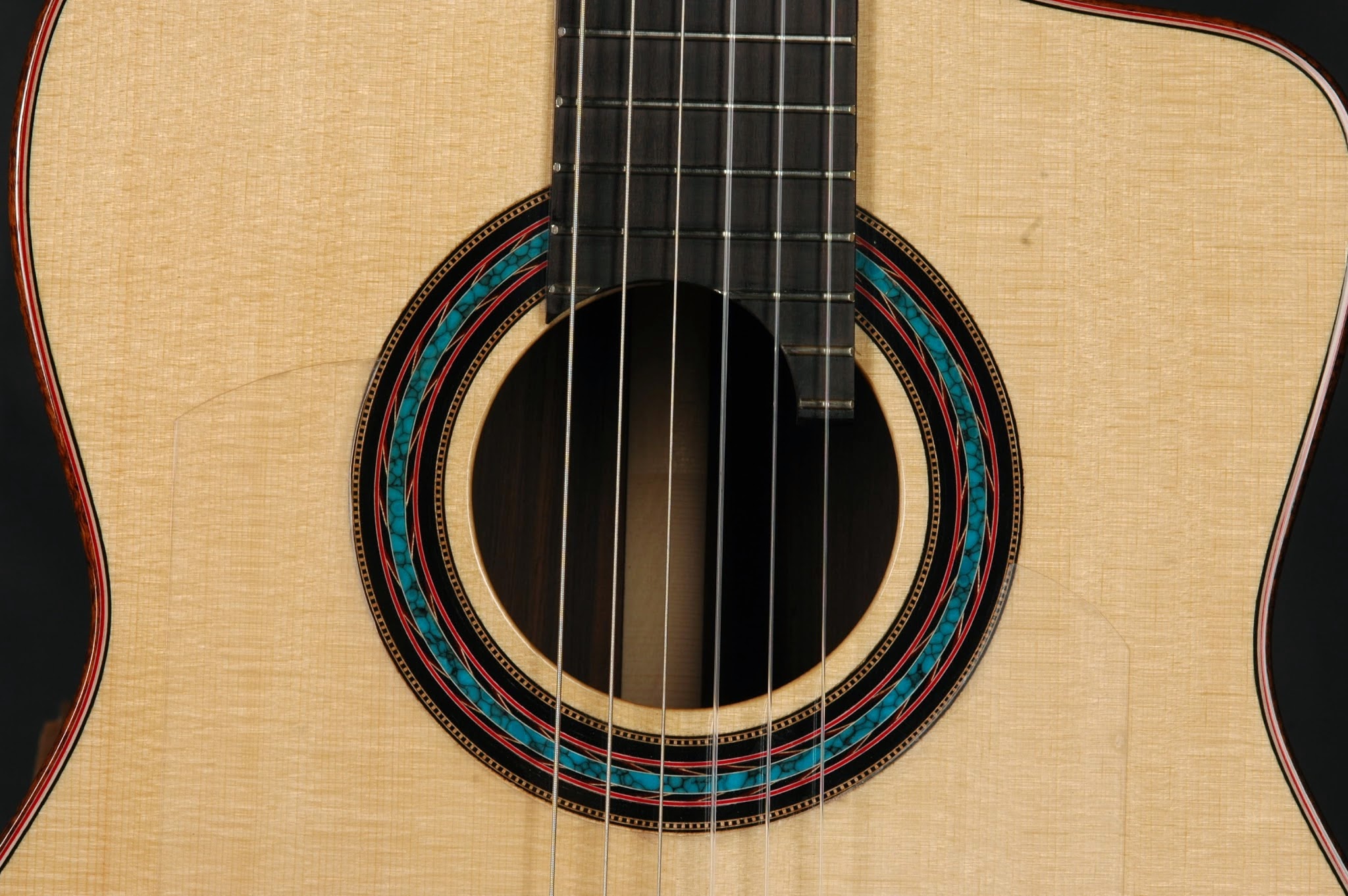
We finished this cut away tenor this last spring. Brazilian Rosewood back and sides, Lutz Spruce top, curly koa bindings. Abalone top and soundhole Martin 5K inlays.

IMG_2138.JPG

Lonora Harpguitar

March 1st, 2010

IMG_1739.JPGIMG_1734.JPG

Sometimes called Bass Guitars or contra-bass guitars these instruments were very popular in the 19th century, primarily in Europe. There were many variations on the size and shape of these instruments. How the Bass strings were supported varied as well, and the number of bass strings that they used were all over the place. Starting with as few as one or two bass strings, it was not uncommon to see guitars with as many as fifteen sub bass strings. Most of these instruments were built pretty heavy by todays standards. The tops are ladder braced and often dont have any bracing below the soundhole. In spite of that they have a surprisingly sweet and intimate sound all their own. If you want to see more photos click here.

Cocolele

January 13th, 2010

This has got to be the Mother of All Cocolele’s! Over the top as far as cocolele ukes go.If anyone has any info on this please let me know. I’ve never seen anything like it, and I’ve seen alot of ukes. Its obvious they were going after a turtle shell look for the back with the coconut shells. The scale length is almost tenor. Neck is curly Koa . Im not sure what the top is but its not Koa. It might be Mango or Monkey Pod. I have no idea who made it and there’s no label. The only possible identifying mark is an arrow head etched on the headstock. IMG_1710.JPGPretty great collectors piece.Ill post more photos later as take it apart for restoration.For more photos click here.

Silent Uke, (ACME)

December 18th, 2009

IMG_1546.JPGMy friend Mike asked me if I could make him a uke that he could cart around places and practice with out being heard.Hes called it His ACME uke. A Mi Si pickup was installed for the times when He wants to be heard, as well as a circuit to plug in a headphone when He wants to be in”silent mode”. It also has an onboard tuner. This is the design he He sent me. It has a decidedly Danish vibe to it so Teak seemed to be a good choice for the body. The electronics were a bit of a challenge as I had to figure out how to integrate all the components together. I had to get some help with that one.IMG_1630.JPGAnd fitting all that stuff into the cavity was also a challange. Aside from that everything went smoothly. Got a custom knob from my friend Dave King who is a fabulous bass builder and  happens to make custom knobs on the side.IMG_1634.JPGI figure its the one piece of jewelry on it so I might as well pick something cool.Fret board is Ebony as well as the headstock  and bridge.For more photos click here.

Rooted in classic building traditions, Kerry Char crafts a wide variety of beautiful and unusual instruments as well as providing museum quality repair and restoration.

The shop is located at:

Kerry Char
Char Lutheries
5922 N. Willamette
Portland, OR 97203